Project
AI Chat
Company
TakeProfit
Year
2025 – 2026
Role
←
back
AI Chat
An AI assistant integrated into a modular trading platform — designed to analyse charts, assist with risk management, answer market questions, and generate indicator code.
Live product: takeprofit.com
Product Design
AI / LLM
Web
Lead
01. A trading platform, adding AI
TakeProfit is a modular trading interface. In fall 2025 the team decided to build an AI assistant — competitors were shipping similar features, and there was already a working internal prototype from the PM: a chat that interacted with the chart.
That prototype became the starting point for a full-scale feature.
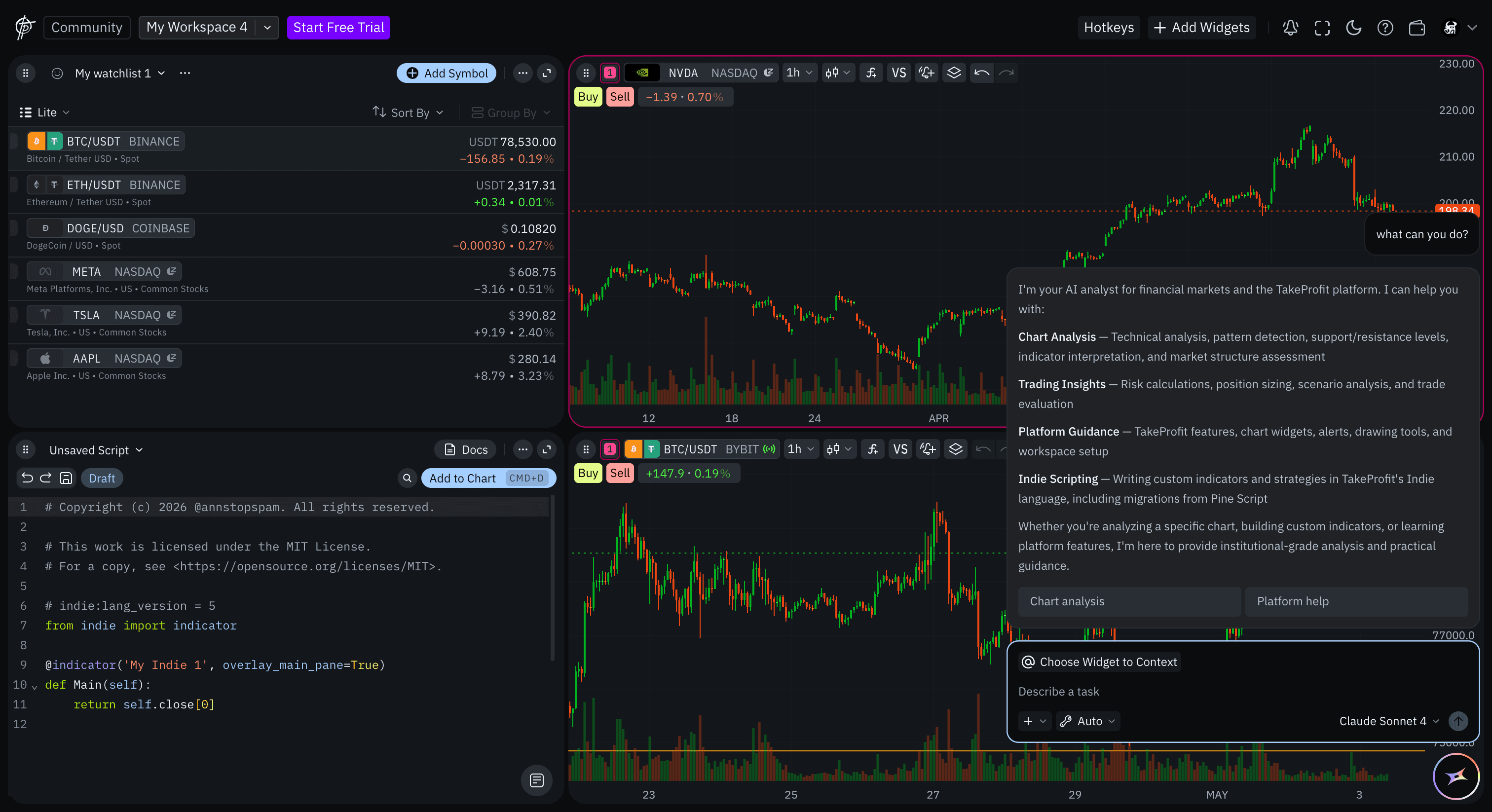
02. How to place the AI inside the product
Looking back: I argued in UX terms. I should have framed it in development risk and cost — the language that mattered in that room.
MY PROPOSAL
Widget
Native to the platform architecture, consistent with existing patterns, easier to integrate.
CHOSEN — CEO
Floating button
Positioned as a distinct product. More prominent, but harder to develop — later a source of friction.
03. Designing the chart
context system
The core of v1 was a context model: the user adds a chart state — ticker, indicators, drawings — directly to a message. The AI works from that snapshot.
I also designed forward-looking pieces — model selection, indicator code generation via AI — knowing they wouldn't ship in v1 but wanting the architecture to accommodate them.
Shipped in v1: Chart context only. Model selection and code gen deferred.
04. Technical limits
surfaced in integration
The problems weren't visible in design — they emerged when real systems met real constraints.
01
Chart architecture — elements could be added but not removed. Actions the AI took couldn't be undone.
02
Performance — visual effects (blur, translucency) were too expensive for the runtime environment.
03
LLM output — tables, emoji, inconsistent structure broke the UI in unpredictable ways.
04
Unstable actions — the AI didn't reliably execute chart actions, making the core promise unreliable.
"By March it was clear: the problem wasn't the interface. The AI wasn't delivering on the product's core promise."
Instead of a single prompt, v2 introduced a system of specialised tools. The AI selects the right tool for each task, and the user can see the reasoning behind each response.
What I added as a designer:
→
Clarifying questions — the AI asks before acting, reducing vague or incomplete responses.
→
Context signals — explicit UI cues when the AI lacks the data it needs.
→
Model selection — finally shipping the forward-looking piece from v1 design.
Released: April 2026
4
core capabilities
~10
months, v1 to ship
Apr '26
release date
→
Chart analysis
Technical analysis, pattern detection, support/resistance levels, indicator interpretation, and market structure assessment
→
Risk management assistance
Risk calculations, position sizing, scenario analysis, and trade evaluation
→
Platform Guidance
TakeProfit features, chart widgets, alerts, drawing tools, and workspace setup
→
Indicator code generation
Writing custom indicators and strategies in TakeProfit's Indie language, including migrations from Pine Script
What I took from this
Three things that shaped how I work now.
01. Ship to learn, not to perfect
The key insight — LLM quality wasn't good enough — could have been discovered months earlier with a leaner test. We waited too long for a complete design.
02. Argue in the language of the room
In the widget vs. button debate I made a UX argument. The decision-maker needed to hear risk and development cost. Same logic, different frame.
03. Design from a live prototype
v2's approach — live prototype first, then design, then integration — was significantly more effective than v1's linear spec-driven process.