Role
Senior Product Designer
Team
2 Engineers
Duration
~8 months · 2025-2026
Status
Shipped · Live
AI Chat
An AI assistant integrated into a modular trading platform — designed to analyse charts, assist with risk management, answer market questions, and generate indicator code.
Live product: takeprofit.com
Product Design
AI / LLM
Web
Lead
01. A working AI prototype became a full-scale product feature
TakeProfit is a modular trading interface. In fall 2025 the team decided to build an AI assistant — competitors were shipping similar features, and there was already a working internal prototype from the PM: a chat that interacted with the chart.
That prototype became the starting point for a full-scale feature.
02. One early decision shaped how the AI would live inside the platform
The central question: should the AI live as a platform widget or as a separate floating button? This one decision shaped everything that followed.
Looking back: I argued in UX terms. I should have framed it in development risk and cost — the language that mattered in that room.
MY PROPOSAL
Widget
Native to the platform architecture, consistent with existing patterns, easier to integrate.
CHOSEN — CEO
Floating button
Positioned as a distinct product. More prominent, but harder to develop — later a source of friction.
03. We built v1 around giving AI direct context from the chart
The core of v1 was a context model: the user adds a chart state — ticker, indicators, drawings — directly to a message. The AI works from that snapshot.
I mapped all the edge cases: what happens when a widget is removed mid-session, how the AI signals what actions it is taking, what happens when context is stale.
I also designed forward-looking pieces — model selection, indicator code generation via AI — knowing they wouldn’t ship in v1 but wanting the architecture to accommodate them.
Shipped in v1: Chart context only. Model selection and code gen deferred.
04. Real integration exposed problems we couldn’t see in design
The problems weren’t visible in design — they emerged when real systems met real constraints.
01
Chart architecture — elements could be added but not removed. Actions the AI took couldn’t be undone.
02
Performance — visual effects (blur, translucency) were too expensive for the runtime environment.
03
LLM output — tables, emoji, inconsistent structure broke the UI in unpredictable ways.
04
Unstable actions — the AI didn’t reliably execute chart actions, making the core promise unreliable.
“By March it was clear: the problem wasn’t the interface. The AI wasn’t delivering on the product’s core promise.”
v1 launch was cancelled.
05. We rebuilt v2 around specialised tools instead of a single prompt
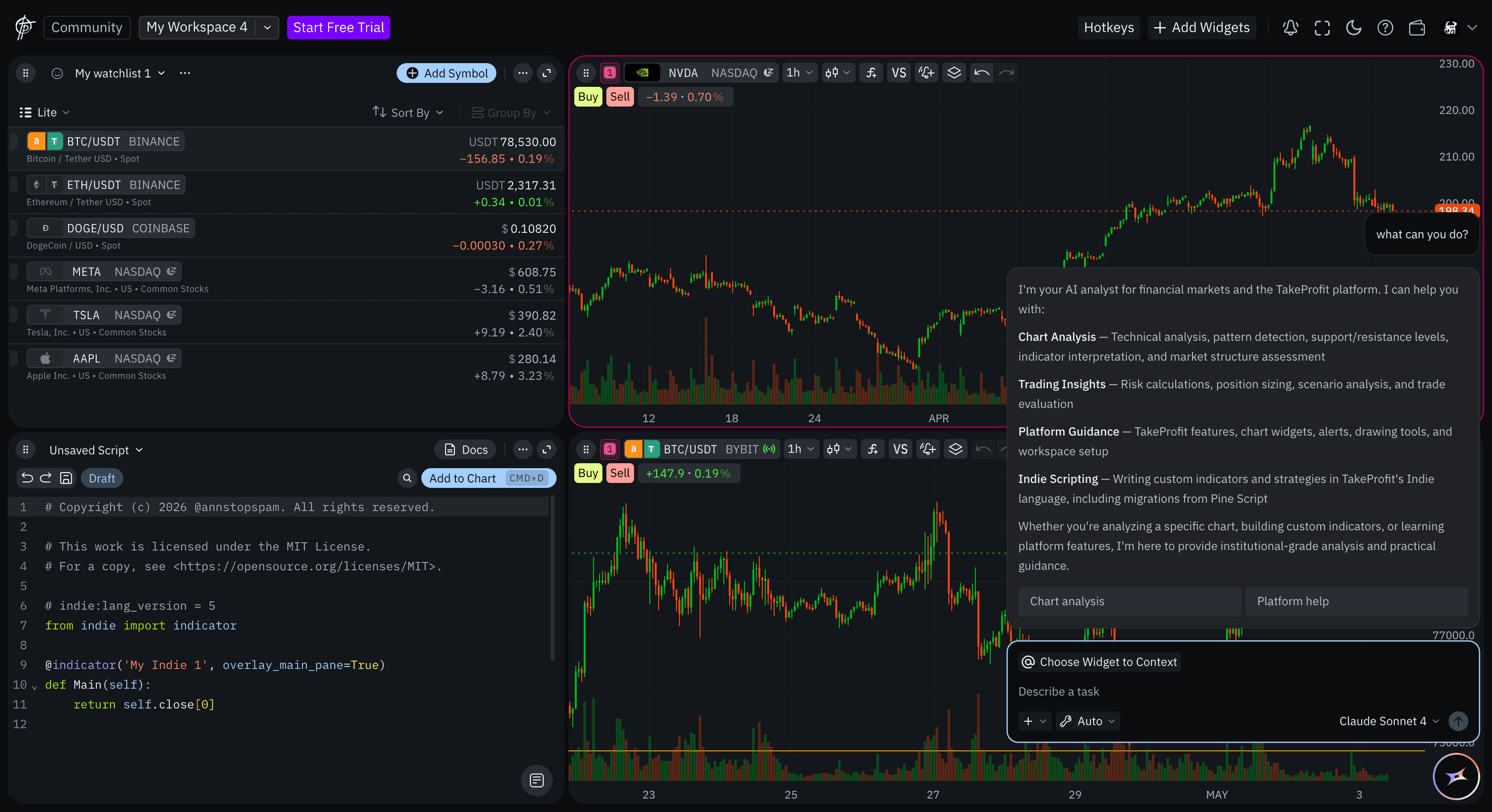
Instead of a single prompt, v2 introduced a system of specialised tools. The AI selects the right tool for each task, and the user can see the reasoning behind each response.
What I added as a designer:
→
Clarifying questions — the AI asks before acting, reducing vague or incomplete responses.
→
Context signals — explicit UI cues when the AI lacks the data it needs.
→
Model selection — finally shipping the forward-looking piece from v1 design.
Released: April 2026
06. The rebuilt AI now handles four core trading tasks
→
Chart analysis
Technical analysis, pattern detection, support/resistance levels, indicator interpretation, and market structure assessment
→
Risk management assistance
Risk calculations, position sizing, scenario analysis, and trade evaluation
→
Platform Guidance
TakeProfit features, chart widgets, alerts, drawing tools, and workspace setup
→
Indicator code generation
Writing custom indicators and strategies in TakeProfit’s Indie language, including migrations from Pine Script
4
core capabilities
~10
months, v1 to ship
Apr ‘26
release date
What I took from designing an AI product
Three things that shaped how I work now.
v2’s approach — live prototype first, then design, then integration — was significantly more effective than v1’s linear spec-driven process.
Ann Latu · Product Designer
anna.latukhova@gmail.com